
A kids coding competition story from Codeavour
At Indus International School Bangalore, Nitya Gaurav Sharma noticed something most students would recognise.
Playground time could get messy.
Kids argued over whose turn came next. Some found it harder to join a game. Shy students could get left behind, and children who needed a little more time did not always get it.
Nitya wondered if she could build something to help. She was 10 years old.
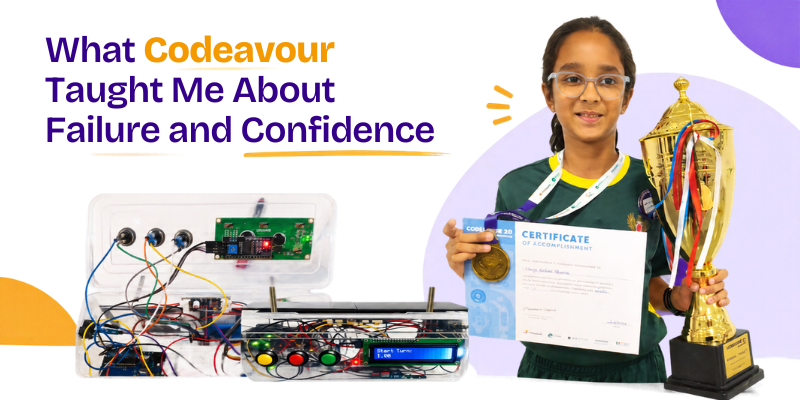
That question eventually became FairPlay Buddy, a smart playground device built for a kids coding competition, and it took Nitya from second place at the Regionals to first place at the India Nationals, followed by the Girls in STEM Award at the Codeavour Internationals.
But the project did not begin with an award in mind. It began with a problem she had seen herself.
Nitya Started Robotics at Indus International School Bangalore
Nitya is a Grade 5 student at Indus International School. Her interest in robotics came from something quite simple: she liked hands-on activities.
She enjoyed thinking of an idea, building it, and finding out whether it actually worked.
At first, robotics was supposed to be a side hobby. That changed once she began spending more time building.
“When I am building something, I feel like I am in my own element.”
That curiosity gave her a starting point. Codeavour gave her somewhere to take it.
The Idea Behind FairPlay Buddy
FairPlay Buddy is designed around a common playground problem: taking turns fairly.
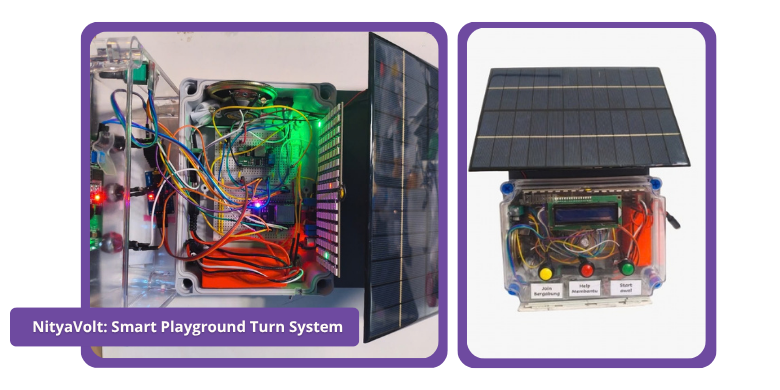
A child presses the JOIN button to enter a queue. The device assigns a turn number and gives each player a fixed amount of playtime. Colour-changing lights make it easier for kids to understand when a turn begins or ends.
Nitya also thought about students who may find playground interactions more difficult.
The device uses multilingual audio and a local-language display. A HELP MODE can provide additional time for children who need extra support.
Instead of relying on someone to constantly decide who plays next, the system gives everyone a visible way to follow the same process.
That became the basic idea behind FairPlay Buddy: make playtime easier to navigate and harder to dominate.
Then She Had to Make It Work
Having the idea was one part of the project. Building it was another.
Nitya used low-cost hardware and PictoBlox block-based coding (the same free tool many students use for their first kids coding competition project) to develop FairPlay Buddy. The device can connect to a hotspot, and the duration of each turn can be configured through Adafruit IO, which she also used to connect the project to a real-time dashboard.
That creates an interesting possibility beyond managing turns. If playground usage data is collected responsibly, schools could better understand how play spaces are being used and apply those observations when planning them.
Nitya also added a small energy-saving feature. When nobody presses a button for two minutes, the display switches off. Pressing a button wakes it again.
None of these features appeared perfectly on the first attempt, and that became part of what she learned.
What Happens When the First Version Fails?
At school, Nitya had learned the Design Thinking Process. FairPlay Buddy gave her a chance to use it on something she was building herself.
She began with the problem, explored possible solutions, built one, tested it, and went back to change what was not working.
Sometimes the design needed fixing. Sometimes it was the code.
“Things don’t always work the first time. You change the design, fix the code and test again.”
For students entering their first kids coding competition, this part of her experience matters.
A working first attempt is not the standard.
If a button behaves differently from what you expected, fix it. If users find something confusing, change it. If your code breaks after adding a new feature, work backwards until you find out why.
The project gets better because you test it, not because the first version was perfect.
Regionals to Nationals to the International Stage
Nitya’s Codeavour journey happened in stages.
- Regionals: 2nd Place
- India Nationals: 1st Place
- Internationals: Girls in STEM Award
Each competition gave her another chance to work on the project and explain it in front of other people.
By the time she reached the international stage, she was not only presenting something she had built. She was much more comfortable explaining why she had built it.
That change mattered to her.
“Codeavour gives every kid a platform to present their skills and ideas to the world.”
She also liked that students could participate individually or as part of a team. For Nitya, having the option to compete independently meant she could take ownership of her project and its presentation.
Presenting the Project Was Part of the Learning
Building FairPlay Buddy taught Nitya about coding and design. Competition brought another challenge: explaining the idea clearly.
A judge has not spent weeks watching your project develop.
They need to understand the problem quickly. They need to see how the solution works and why you made certain choices.
Nitya found the judges at the Codeavour Internationals welcoming, and felt that participants were given a fair opportunity to present their work.
With each stage, speaking about FairPlay Buddy became easier.
For another student preparing for an international robotics and AI competition, this is worth practising alongside the project itself.
- Can you explain your problem without reading from a screen?
- Can you demonstrate the project while you speak?
- Can you answer a question when the judge asks something you did not rehearse?
That practice can expose gaps in the project too. If something is difficult to explain, it may need more thought.
Why the Girls in STEM Award Stayed With Her
At the international prize distribution, Nitya noticed the Girls in STEM Award.
She liked that girls could be recognised for their work even outside the main podium positions. For a young student interested in robotics, seeing that category made participation feel more open.
Later, she received the award herself.
For Nitya, the recognition brought confidence. It also gave her the experience of taking an idea she had built at school and presenting it on a global stage.
Her experience is one small example of why a Girls in STEM category within a kids coding competition can matter. Recognition can give young students another reason to keep building after the competition ends.
What Every Kids Coding Competition Teaches Beginners
FairPlay Buddy did not start with a search for an impressive technology.
It started with Nitya noticing something around her.
That is a useful place to begin if you want to build your own project.
Look at school. Look at your neighbourhood. Pay attention to something people repeatedly struggle with. Then ask whether you can make one part of it easier.
Once you have a problem, write down who experiences it. Build the smallest version of your solution that can be tested. Put it in front of someone. Watch what happens.
Then change it.
You do not need every feature on day one.
Before Entering a Robotics Competition, Ask Yourself This
A competition project becomes easier to develop when you can answer a few basic questions.
What problem am I solving?
Be specific. “Improving playgrounds” is broad. “Helping kids take turns fairly during playground games” gives you something you can actually design around.
Who will use it?
Think about the real person using your project. Nitya considered children who might need additional support, which influenced features such as HELP MODE and multilingual guidance.
Does the technology have a job?
A sensor, AI model, or IoT dashboard should solve something in the project. Adding technology only because it sounds advanced usually makes the idea harder to explain.
Have I tested it enough?
Try the project in situations you did not design for. Let someone else use it without telling them exactly what to do. Their confusion can teach you a lot.
Can I explain it simply?
If you can describe your project to a classmate in a minute, you probably understand it well enough to start preparing for judges.
You Don’t Have to Know Everything Before You Start
This is the part Nitya wants other students and her friends at Indus International School Bangalore to know.
You can start before you know exactly how to build the final version.
“If you have an idea, try it.”
Her advice is to build something small first. Test it. Learn from what goes wrong. Then improve it.
She especially wants girls who are curious about robotics or STEM to give their ideas a chance.
The problem you notice might be completely different from FairPlay Buddy. Good. It should be yours.
As Nitya puts it:
“No idea is a bad idea. Sometimes, you just need to refine it a little, test it again and keep going!”
For her, the journey is still beginning.
You Don’t Have to Know Everything Before You Start
This is the part Nitya wants other students and her friends at Indus International School Bangalore to know.
You can start before you know exactly how to build the final version.
“If you have an idea, try it.”
Her advice is to build something small first. Test it. Learn from what goes wrong. Then improve it.
She especially wants girls who are curious about robotics or STEM to give their ideas a chance.
The problem you notice might be completely different from FairPlay Buddy. Good. It should be yours.
As Nitya puts it:
“No idea is a bad idea. Sometimes, you just need to refine it a little, test it again and keep going!”
For her, the journey is still beginning.
Start Your Own Codeavour Journey
Students interested in AI, coding, or robotics can explore Codeavour and find a track that fits the kind of challenge they want to take on.
Some may want to develop an original solution to a problem they care about, using free tools like PictoBlox the same way Nitya did. Others may be interested in an AI robotics challenge or the Robo Soccer League.
Schools can also explore ways to bring students into a kids coding competition of their own, while organisations interested in building participation locally can look at Codeavour partnership opportunities.
You do not need to begin with an international-stage project.
Nitya began with something she noticed on a playground. Then she started building.